There are a bunch of YouTube videos that show this method, one of them that I started with was from this Corey’s Cave video.
The soil method is the most versatile as it can be used for all types of seeds and I would recommend it to someone who is just starting on growing microgreens. It is also the most inexpensive way to get started.
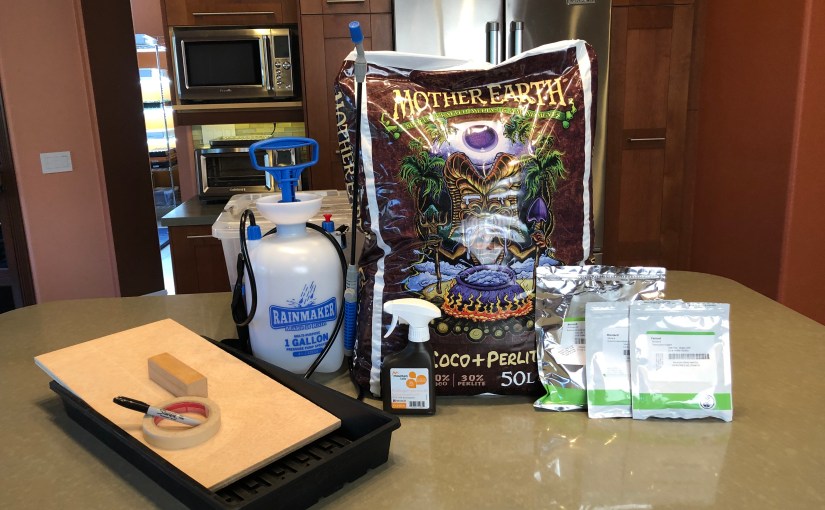
Equipment you will need:
- Growing trays
- Trays you will need are the standard 1020 trays. You can get them from your local hydroponic store, I get mine at San Diego Hydro in San Marcos. I would recommend getting thicker trays, they are slightly more expensive but worth it in long run
- Another place to get it online is from Bootstrap farmer, they also sell them on Amazon.
- Sprayer
- I am using Rainmaker sprayer, this is the same sprayer that I use for the coco mat method.
- Hydrogen Peroxide Spray bottles
- Got them from Amazon. I now buy them in bulk from Costco and refill the spray bottles.
- Soil
- The “soil” I use is a Coco coir and vermiculite mix. It is a sterile media, similar to the coco mat but has soil like texture. I get it at my local hydroponic store. It is available on Amazon as well but is very expensive there, I will not recommend to get it from there unless absolutely necessary.
- Folks have used potting mixes for this as well, try to get it as fine as possible. I have not tried this.
- Water
- I use filtered water from my reverse osmosis filter that I use at my home. Tap water contains chlorine and/or Chloramine that needs to be removed.
- Seeds
- I ordered seeds from True Leaf Market. They carry Non-GMO seeds and I had had good
- Broccoli, Kale and Cabbage are the easiest microgreens to grow, they do not have strong flavor and can be used in salads and smoothies as well. I will recommend to start with those until you get confidence.
- Tamper
- A piece of plywood the size of inside of the 1020 tray to tamp the soil. I bought a piece of plywood from Home Depot and cut it myself, alternatively, take measurements with you and Home Depot can cut it for you.
Method
- Take a clean 1020 tray and fill it with soil. I use 3 scoops of 32 Oz yoghurt container
- Spread the soil evenly, it should be roughly at the half-way mark of the tray
- Use tamper to tamp down the soil and make an even surface
- Wet the soil, I use the sprayer and use the technique of painting – paint with horizontal strokes first and then vertical. I do 2 such “coats of paint”
- Spread the seeds as evenly as possible – this is very important – clumps of seeds can cause mould and need to be avoided. Use 2 tablespoon of seeds (for Broccoli, Kale, Cabbage). Use either the tablespoon and tap it to spread evenly or spread them with your hands if you are more comfortable with them.
- Do a light spray of hydrogen peroxide, this helps reduce any mould and it is perfectly safe as it is just additional oxygen atom to our H2O.
- It is good idea to label your tray with date of the planting and the crop type. I use a a 1/2 inch painter’s tape and a sharpie for this.
- Now stack the trays on top of each other – this help with the germination and builds the strength of the the micro green stems. I usually stack them up to 4 trays. Add an empty tray at the top and add some weight to it, I use my 2 pound dumbbells.
- Set aside these stack of trays for 3 days, you will see the microgreens starting to grow and push the trays up – it is amazing how effective weight lifters these tiny plants are.
- After about 3 days, it is time to unstack them. Keep the trays uncovered on a table near a window where you get good sunlight. The plants are yellow due to lack of light and once you open them to light, they green up in a day – it is amazing to see
- Check the moisture level of the soil by feeling the soil, it should feel like a wrung out sponge. If you feel that the soil is dry, pour some water from the sides of the tray. Try to minimize wetting the plants themselves, or wetting the soil too much. Overwatering or wetting the plants can use mould to grow.
- The microgreens take minimum 7 more days to be ready for harvesting, the actual days depends on the amount of light you have, but don’t wait for more than 10 days. When they are taller than the walls fo the tray and when you see the first leaves spread out – it is time to harvest
- To harvest, I just use a pair of sharp scissors. Hold a bunch of microgreens with one hand and use scissors with other hand to cut the stems – cut at least 1 cm above the soil. I generally harvest the whole tray at once and save the microgreens in a container in the fridge. I used to cut as needed before but the soil where the microgreens are cut starts getting mould quickly. Cut microgreens stay in the fridge for a week easily.
- After the tray is cut, I put the used soil in my compost to be used in my garden. Reusing the soil is not recommended as it can be unhygienic.
Pros with this method:
- Easy, inexpensive way to get started
- Minimal effort needed in preparing the trays and maintaining them
- Can be used for all types of seeds. Larger seeds like peas and sunflower require this method.
Cons of this method:
- Less forgiving for mould issues – watering needs to be properly managed
- Harvesting needs more care as it is easy to pull out some microgreens with soil during cutting
 Let's Grow Greens